
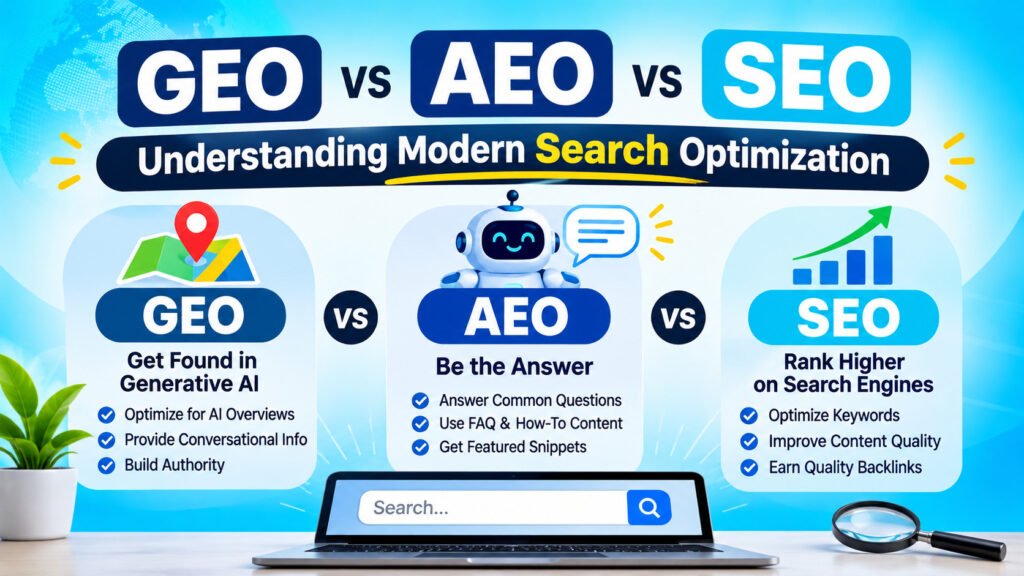
A few years ago, “doing SEO” meant helping your website rank on Google. Today, people also ask ChatGPT, Gemini, Perplexity and Google’s AI features for recommendations and answers. And suddenly the industry is full of new short forms: GEO, AEO, LLMO, AI SEO. If you run a business, this can feel confusing, and a little scary. Do you need to replace SEO? Do you need three separate strategies and three separate budgets? The honest short answer: no, not usually. In this guide, I’ll explain what each term means, how they differ, where they overlap and what a sensible plan looks like for a small or growing business.
The Quick Answer
| SEO | AEO | GEO | |
| Stands for | Search Engine Optimization | Answer Engine Optimization | Generative Engine Optimization |
| Main goal | Rank pages in search results and earn clicks | Be the direct answer to a question | Be mentioned or cited in AI-generated responses |
| Where it shows | Google, Bing results, Maps | Featured snippets, voice assistants, AI answer boxes | ChatGPT, Gemini, Perplexity, AI Overviews and similar tools |
| Focus | Technical health, content, links, local signals | Clear question-and-answer content, structure | Authority, original information, brand mentions, clarity |
| Typical measures | Rankings, impressions, clicks, leads | Snippets, answer visibility | Mentions, citations, referral visits |
The key point: These three are not rivals. They sit on top of each other. SEO is the foundation, AEO shapes how your content answers questions, and GEO is about being trusted enough to be used by AI tools.
What is SEO?
Search Engine Optimization (SEO) is the practice of improving your website so search engines can find, understand and rank it, and so people actually want to use it. SEO includes:
- Technical SEO: crawlability, speed, mobile usability, structured data
- On-page SEO: helpful content, titles, headings, internal links
- Off-page SEO: links, mentions and reputation across the web
- Local SEO: Google Business Profile, citations, reviews, location signals
If you’re new, start with our beginner guide: What is SEO and How Does It Help a Business Grow? SEO is still the base layer. If search engines can’t crawl or trust your site, neither snippets nor AI tools are likely to use it.
What is AEO?
Answer Engine Optimization (AEO) means structuring your content so that a search engine or assistant can pull out a clear, correct answer to a specific question. Think of searches like:
- “How much does SEO cost in Bangladesh?”
- “What is the difference between WordPress and Shopify?”
- “Is Google Ads better than Facebook Ads?”
AEO is about writing the answer first, in plain language, then supporting it. Common AEO practices include:
- Question-style headings that match real searches
- A short, direct answer (often 40-60 words) right under the heading
- Helpful lists, tables and step-by-step sections
- Honest FAQ sections
- Accurate structured data where it applies
AEO overlaps with the “featured snippet” and “People also ask” world and with voice search. A practical example from Our blog is How Much Does SEO Cost in Bangladesh in 2026, a question people really ask, answered directly.
What is GEO?
Generative Engine Optimization (GEO) is about improving your visibility inside answers written by generative AI tools, such as ChatGPT, Gemini, Perplexity, Microsoft Copilot and Google’s AI Overviews and AI Mode. These tools don’t just list links. They read many sources and write a response, sometimes naming brands or linking to sources. GEO tries to make your business a trusted, clear and easy-to-understand source that these systems may use or cite. GEO usually involves:
- Original, specific information (real data, real examples, first-hand experience), not generic text
- Clear entity signals: who you are, what you do, where you operate, who your team is
- Consistent brand information across your website, social profiles and directories
- Mentions and reviews on trusted third-party sites
- Well-organized content that covers topics deeply and links related pages together
- Allowing legitimate crawlers to access pages you want to be found
So, Are They Really Different? An Honest Take
Here’s something many agencies won’t tell you:
- The terms are used inconsistently. Some people use AEO and GEO to mean the same thing. Others split them, as I did above. Some call all of it “AI SEO”
- Google itself says that, for its own AI search features, optimizing for generative AI search is still, in practice, optimizing for the search experience, which is SEO. It acknowledges that terms like AEO and GEO are in use, but doesn’t treat them as a separate system
- Other AI tools work differently. ChatGPT, Perplexity and others have their own sources and behaviors, which change often, and nobody outside those companies can guarantee how they choose what to cite
So the useful way to think about it is as layers of the same goal: be easy to find, easy to understand and worth trusting.
What We can’t promise: No agency can honestly guarantee that an AI tool will mention your brand, or that you’ll rank first on Google. Be cautious of anyone who does.
What They Have in Common
All three rely on the same fundamentals:
- Helpful, original content written for people first
- E-E-A-T signals: Experience, Expertise, Authoritativeness and Trustworthiness. We explain this in detail in What is E-E-A-T and Why Does Google Care About It?
- A Technically healthy, fast, mobile-friendly website, which is part of professional web design
- Clear structure: headings, short paragraphs, internal links
- Accurate business information everywhere your brand appears
- A good reputation: reviews, mentions and links from reliable sources
If you do these well, you’ve already done most of the work for all three.
Where They Differ in Practice
Content style
- SEO: comprehensive pages targeting a topic and its related searches
- AEO: answer-first sections, FAQs and concise definitions
- GEO: original insights, sourced facts and clear brand/entity information that AI can summarize accurately
Where you build trust
- SEO: mostly your own website plus links
- AEO: your own content structure
- GEO: your whole online footprint, including reviews, listings, social profiles and mentions elsewhere
How you measure it
- SEO: rankings, traffic, calls, leads
- AEO: snippet and “People also ask” presence
- GEO: brand mentions in AI answers, referral visits from AI tools, branded search growth. This area is still hard to measure precisely, and tools differ
Which One Does Your Business Need First?
Start with SEO. Then layer on AEO and GEO.
| If your business is… | Focus first on… |
| A local shop, clinic or service in Bangladesh | Local SEO and Google Business Profile, then FAQ-style content. See How to Optimize Your Google Business Profile for More Leads |
| A new website with little content | Technical SEO and core service pages, then helpful guides |
| An online store | Category and product page SEO, product FAQs, reviews |
| A service business with lots of questions from customers | AEO-style content: clear answers, comparisons and costs |
| An established brand with strong content | GEO: consistency, mentions, original data and entity clarity |
Decide between paid and organic channels as well. Our post on SEO vs Google Ads: Which Is Better for Small Businesses? can help, and if you’re comparing ad platforms, Read Facebook Ads vs Google Ads.
A Practical Plan to Prepare for Modern Search
Step 1: Fix the foundation
Make sure your site is crawlable, fast and secure, with clean titles, headings and internal links. If your platform is holding you back, see WordPress vs Wix vs Shopify: Which Platform Is Best for Your Business?
Step 2: Know your customers’ real questions
Use customer calls, WhatsApp messages, Google Search Console and “People also ask” to list the questions people actually ask, including in Bangla or mixed Bangla-English where relevant.
Step 3: Write answer-first content
Put a clear, honest answer near the top of each section, then expand with detail, examples and caveats.
Step 4: Show real people and real experience
Add author names, short bios, company details, case studies and a clear contact page. Anonymous, generic content is harder to trust, for readers and machines. You can explore Our case studies and About page for an example of how we present this.
Step 5: Keep your brand details consistent
Your name, address, phone, services and descriptions should match across your website, Google Business Profile, social media and directories.
Step 6: Use structured data carefully
Mark up what’s actually on the page (organization, local business, articles, products, FAQs where appropriate). Never add markup for content that visitors can’t see.
Step 7: Build Real-world authority
Earn mentions, reviews and quality links through genuinely useful work, and be present where your customers are. Social media is part of this, which is why our social media marketing work supports brand visibility too.
Step 8: Consider programmatic and large-scale content carefully
If you have a lot of similar pages (locations, products, comparisons), scale only if each page is genuinely useful. Read What is Programmatic SEO and When Should You Use It? before you try it.
Step 9: Track, Review and Update
Check Search Console monthly. Watch for referral visits from AI tools in your analytics, test key questions in AI assistants, and refresh old content when facts change.
Common Mistakes to Avoid
- Treating GEO and AEO as a replacement for SEO
- Publishing mass AI-written content with no expert review or original input
- Keyword stuffing or writing “for robots” instead of people
- Chasing every new acronym instead of fixing the basics
- Fake reviews, fake authors or invented statistics. They damage trust fast
- Blocking legitimate crawlers by accident through robots.txt or security settings
- Ignoring local and brand consistency
- Believing guarantees about rankings or AI citations
Extra Care for YMYL Topics
If your website covers health, finance, law, safety or other “Your Money or Your Life” topics, AI systems and search engines both expect a higher level of trust. A wrong answer can seriously affect someone.
- Have content written or reviewed by a qualified professional, and show real credentials
- Cite Official, primary sources and show when the page was last reviewed
- Provide general information, not personal medical, legal or financial instructions
- Avoid miracle claims, guarantees and pressure tactics
- Be transparent about who you are, how to contact you and how you make money
- Add a clear disclaimer, and tell readers to consult a professional
When AI tools summarize your content, accuracy matters even more, because a short, wrong answer can spread.
How Long Does It Take to See Results?
There is no fixed timeline. SEO is a long-term process, and results depend on your industry, competition, site condition and consistency. Many businesses need several months of steady work before they see meaningful growth. AI visibility changes even faster and is less predictable, so treat it as an extension of good SEO, not a quick fix.
Frequently Asked Questions
What is the difference between GEO, AEO and SEO?
SEO improves visibility in traditional search results. AEO structures content so it can be used as a direct answer. GEO aims at being cited or mentioned in AI-generated responses. They share the same foundation of helpful, trustworthy content.
Is GEO Replacing SEO?
No. GEO and AEO build on SEO. If your site isn’t crawlable, useful and trusted, it’s unlikely to perform well in any of them.
Are AEO and GEO the same thing?
Not everyone agrees. Some people use them interchangeably, while others separate them by where the answer appears (snippets and voice for AEO, generative AI responses for GEO). Focus on the practices, not the label.
Does Google use GEO or AEO?
Google’s own guidance treats optimizing for its AI search features as part of SEO. The terms GEO and AEO are industry language.
How can I get my business mentioned by ChatGPT or other AI tools?
There’s no guaranteed method. What helps is clear, original, accurate content, consistent brand information, real reviews and mentions, and a technically healthy site that legitimate crawlers can access.
Do small businesses need GEO or AEO?
Small businesses should start with strong SEO, especially local SEO, and write clear, answer-first content. That naturally covers much of AEO and GEO.
How do I measure AI search visibility?
Track referral visits from AI tools in your analytics, watch branded searches, and test your key questions in several AI assistants. Tools vary, and results can differ by user and location, so treat the data as directional.
Can Taqi IT help with this?
Yes. Our SEO service covers technical SEO, content, local SEO and the answer-focused content structure that supports AI search. Contact us to discuss what fits your business.
Final Thoughts
GEO, AEO and SEO are not three competing strategies. They are three ways of looking at one goal: being the clear, trustworthy and helpful answer when your customers are looking. Get your SEO foundation right, write answer-first content, keep your brand information consistent and keep building real authority. If you do that, you’ll be ready for whatever form search takes next. If you’d like help planning your search strategy, get in touch with Taqi IT for a free consultation, or explore our SEO, web design and social media marketing services.