
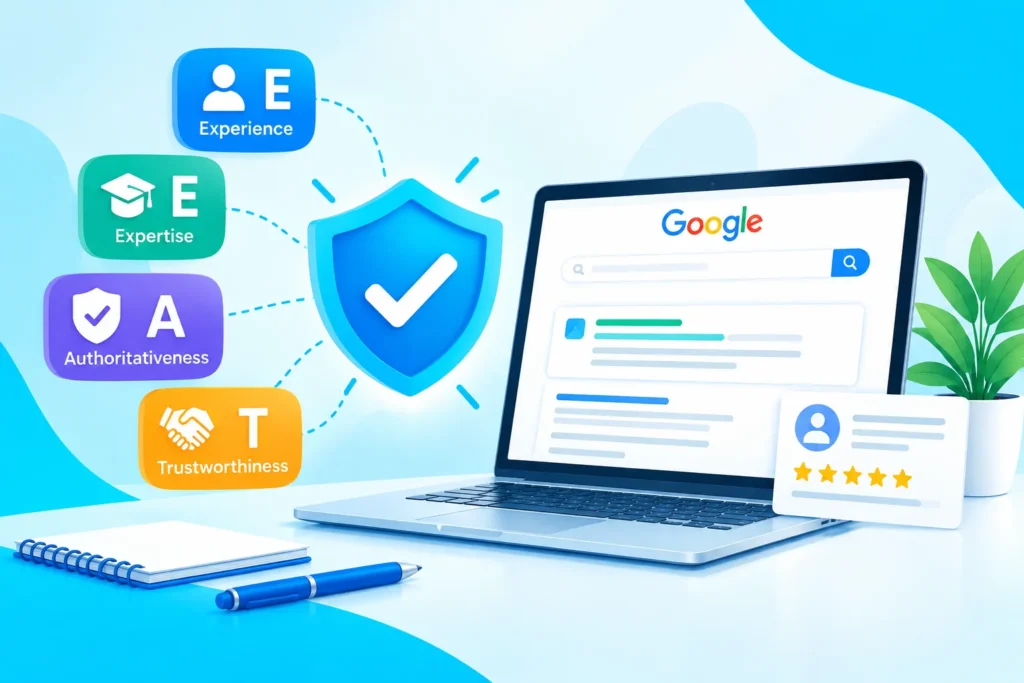
When you search Google for information, you expect the results to be useful, accurate, and trustworthy. This becomes even more important when the information can affect your health, finances, safety, education, or other important decisions. This is where E-E-A-T comes into the conversation. E-E-A-T stands for Experience, Expertise, Authoritativeness, and Trustworthiness. It is part of Google’s Search Quality Rater Guidelines and provides a framework for evaluating the quality of content and the people or organizations behind it.
But there is an important point to understand: E-E-A-T is not simply a checklist that guarantees higher Google rankings. Google’s search quality raters use these concepts to evaluate the quality of search results and provide feedback that helps Google understand whether its systems are producing helpful results. Rater scores themselves do not directly determine rankings. For businesses and website owners, however, E-E-A-T provides a useful way to think about how trustworthy and valuable your website is to real users.
What Does E-E-A-T Mean?
Let’s break down each part of E-E-A-T.
Experience:
Experience refers to the extent to which the content demonstrates that someone has actually experienced or interacted with the subject. For example, imagine you are reading a review of a laptop. One article simply repeats the manufacturer’s specifications. Another explains how the writer actually used the laptop for several months, including its battery life, keyboard, performance, and limitations.
The second article may demonstrate stronger first-hand experience. Experience can be especially useful for product reviews, travel guides, tutorials, case studies, personal experiences, and practical advice. For businesses, you can demonstrate experience by publishing:
- Real project case studies
- Original photos
- Client experiences
- Before-and-after examples
- Practical tutorials
- First-hand observations
- Detailed project results
- Lessons learned from real work
The goal is not to claim experience you do not have. It is to show genuine experience where it exists.
Expertise:
Expertise refers to the knowledge and skill demonstrated by the content creator or organization. For example, medical information should ideally be written or reviewed by appropriately qualified professionals. Financial content should be created with relevant knowledge and care. Technical SEO content should demonstrate an actual understanding of search optimization rather than simply repeating common definitions. Expertise can be demonstrated through:
- Author credentials
- Professional experience
- Qualifications
- Relevant certifications
- Industry knowledge
- Detailed explanations
- Accurate information
- Original research
- References to trustworthy sources
Your website should make it reasonably clear who created important content and why that person or organization is qualified to discuss the topic.
Authoritativeness:
Authoritativeness is about the reputation and credibility of the content creator, website, or organization. Think about two websites providing information about the same subject. One is an established organization with a strong reputation in that field. The other has no clear information about who operates it. Users are more likely to trust the source with clear identity, relevant expertise, and a credible reputation. You can strengthen your website’s authority by building a genuine reputation through:
- High-quality content
- Industry recognition
- Expert contributions
- Relevant mentions
- Genuine customer reviews
- Case studies
- Professional profiles
- Quality backlinks
- Transparent company information
Authority should be earned rather than manufactured. Buying low-quality backlinks, creating fake reviews, or making unsupported claims may create the appearance of authority without actually building trust. Google’s Search guidance emphasizes reliable and helpful information, and its systems consider factors such as expertise and the reliability of sources when determining useful results.
Trustworthiness
Trust is arguably the most important part of E-E-A-T. A website can have knowledgeable authors and plenty of content, but if users cannot determine who operates the site or whether the information is reliable, trust can suffer. Trustworthiness can be supported by:
- Accurate information
- Clear contact details
- About Us information
- Author information
- Transparent business identity
- Secure website connections
- Clear policies
- Honest claims
- Genuine reviews
- Proper citations and sources
- Easy ways to contact the business
For ecommerce websites, clear information about products, pricing, shipping, returns, and customer support is particularly important. For service businesses, visitors should be able to understand what the company does, who provides the service, and how they can contact the business.
Why is E-E-A-T Especially Important for YMYL Topics?
You may have heard the term YMYL, which means Your Money or Your Life. YMYL topics can affect a person’s health, financial stability, safety, legal situation, or overall well-being.
Examples include:
- Medical advice
- Mental health information
- Financial planning
- Investment information
- Legal guidance
- Insurance
- Public safety
- Important educational decisions
For these topics, inaccurate information can potentially cause serious harm. That is why websites publishing YMYL content should take accuracy and trust especially seriously. For example, a health article should not make unsupported medical claims. It should clearly identify its author or reviewer when appropriate, use reliable sources, and distinguish general educational information from professional medical advice. Similarly, a financial article should avoid presenting risky financial decisions as guaranteed outcomes. The standard should always be: Would a reasonable person trust this information enough to make an important decision?
How E-E-A-T Can Improve Your Website?
E-E-A-T is not something you improve by adding the phrase “E-E-A-T” to your website. Instead, you improve it by making the entire website more useful, transparent, and credible.
Create Author Profiles
If your website publishes expert content, introduce the authors. Include relevant information such as:
- Name
- Professional role
- Experience
- Qualifications
- Relevant expertise
- Professional profile
This helps readers understand who is responsible for the information.
Publish Original Content
Avoid creating articles that simply rewrite what dozens of other websites have already said. Add something useful. For example, instead of writing a generic SEO guide, you could publish a case study explaining how a real website was audited, what problems were discovered, what changes were implemented, and what happened afterward. Original insights make content more useful and demonstrate practical experience.
Use Reliable Sources
When making factual or important claims, use trustworthy sources. For topics involving health, finance, law, science, or government information, prioritize authoritative sources. Citing reliable sources also makes it easier for readers to verify important information.
Keep Content Updated
Information changes. SEO practices, technology, laws, product specifications, pricing, and industry standards can all change over time. Review important content regularly and update information when necessary. Do not change the publication date simply to make an old article appear new. Update the content when there is a genuine reason to do so.
E-E-A-T and SEO: How Are They Connected?
E-E-A-T and SEO are closely related because good SEO is not only about keywords. Modern search systems aim to provide useful results that satisfy the user’s search intent. Google’s guidance says its ranking systems consider multiple factors, including relevance, usability, expertise of sources, and other contextual signals. This means your SEO strategy should focus on more than keyword placement. A strong SEO strategy should consider:
- Search intent
- Content quality
- Technical SEO
- Website usability
- Internal linking
- Author credibility
- Original information
- Helpful content
- Website reputation
- User trust
Taqi IT’s SEO services can support businesses with technical SEO, on-page optimization, content strategy, and broader organic search optimization. The objective should be to create a website that is genuinely useful to people while making it easier for search engines to understand the business and its content.
E-E-A-T Starts With a Good Website
Your website itself is an important part of your credibility. A slow, confusing, outdated, or poorly structured website can make it difficult for users to find important information.
Your website should make essential information easy to access, including:
- About your company
- Services
- Contact information
- Team members
- Customer reviews
- Case studies
- Policies
- Relevant expertise
- Helpful content
A professional website can also improve usability across desktop and mobile devices. If your website needs a stronger foundation, Taqi IT provides Web Design & Development services focused on creating professional, user-friendly websites.
E-E-A-T and Social Media
Your business reputation does not exist only on your website. People may also discover your brand through social media, online reviews, videos, business listings, and other platforms. Consistent and professional communication across these channels can help people understand your business and interact with your brand. Taqi IT also provides Social Media Marketing to help businesses build their online presence and communicate with their target audience. Social media alone does not guarantee better Google rankings, but it can contribute to broader brand visibility and customer engagement.
Common E-E-A-T Mistakes to Avoid
Many websites make avoidable mistakes when trying to appear more authoritative.
Avoid:
Fake expertise: Do not claim qualifications or experience that you do not have.
Fake reviews: Genuine customer feedback is far more valuable than manufactured reviews.
Unsupported claims: Avoid statements such as “guaranteed #1 ranking” or “100% guaranteed results.”
Anonymous content: Important content should have clear ownership or authorship where appropriate.
Copied content: Rewriting information from competitors without adding value does not demonstrate genuine expertise.
Outdated information: Regularly review important pages and correct outdated claims.
Keyword stuffing: Repeating keywords does not make content more trustworthy.
Google also has spam policies covering practices intended to manipulate search visibility. Websites that violate these policies can face ranking or visibility consequences.
How to Build an E-E-A-T-Friendly Content Strategy
A practical approach is to build content around real customer questions and your actual expertise. For example, a digital marketing agency could publish:
- SEO case studies
- Local SEO guides
- Technical SEO tutorials
- Google Business Profile guides
- Website optimization tips
- Industry research
- Client success stories
- Expert interviews
- Digital marketing FAQs
Each article should have a clear purpose.
Ask yourself:
Does this content answer the user’s question?
Is the information accurate?
Can we demonstrate real experience?
Is the author qualified to discuss the subject?
Are important claims supported by reliable sources?
Can visitors easily understand who created this content?
These questions can help you create content that is useful for people rather than content created only to target search engines.
Final Thoughts
E-E-A-T stands for Experience, Expertise, Authoritativeness, and Trustworthiness. It is an important concept for understanding what high-quality content and trustworthy websites should look like. It is not a magic ranking formula, and simply adding author bios or certifications will not automatically make a page rank higher. Instead, E-E-A-T should influence how you build your entire online presence. Show genuine experience. Demonstrate real expertise. Build authority through valuable work and a credible reputation. Most importantly, earn the trust of your visitors. For Businesses, This means combining trustworthy content with a technically strong website, a clear brand identity, useful customer information, and a consistent SEO strategy. When your website is genuinely helpful to people, transparent about who is behind it, and supported by real expertise, you create a stronger foundation for long-term organic growth.