
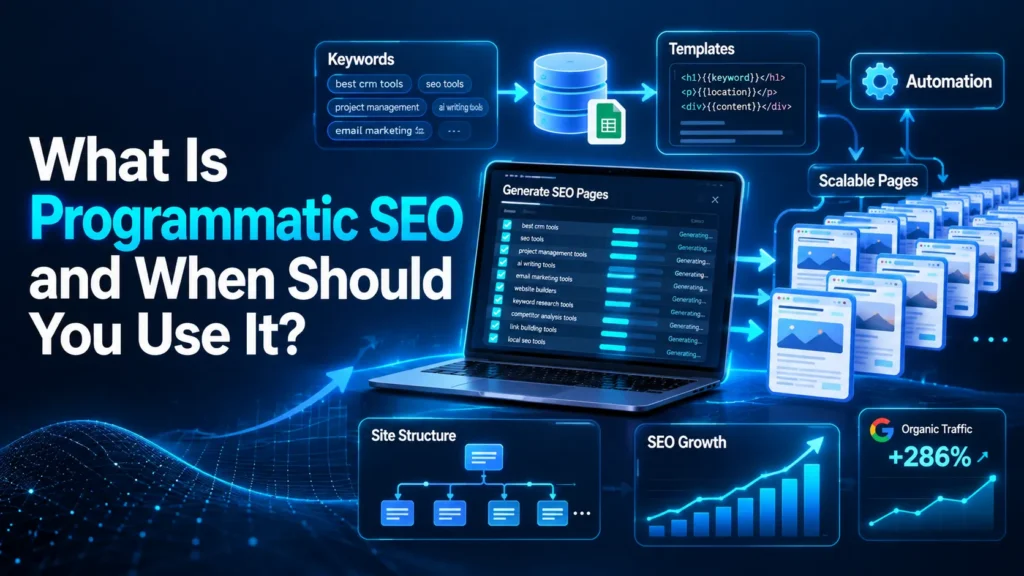
Creating individual SEO pages for hundreds or thousands of keywords can take a lot of time. This is where programmatic SEO can be useful. Programmatic SEO is an approach that uses templates, structured data, databases, and automation to create many search-focused pages at scale. Instead of manually creating every page from scratch, businesses create a reliable page structure and populate it with unique, useful information. For Example, A business directory may create pages for different cities, a travel website may create pages for destinations, or an eCommerce website may generate product and category pages from a large product database.
However, Programmatic SEO is not simply about creating thousands of pages as quickly as possible. If the pages provide little unique value, repeat the same information, or exist mainly to attract search traffic, they can create a poor user experience and SEO problems. Google’s current guidance emphasizes helpful, reliable, people-first content and warns against producing large amounts of content primarily to manipulate search rankings. In this guide, you will learn what programmatic SEO is, how it works, when to use it, when to avoid it, common examples, risks, and how to build a programmatic SEO strategy that provides genuine value to users.
What is Programmatic SEO?
Programmatic SEO is a method of creating large numbers of web pages using a repeatable template, structured data, and automation. Instead of manually writing every page, you create a system that can produce pages based on a set of inputs. For Example, imagine a website that provides information about hotels in different cities.
Instead of manually creating:
- Hotels in Dhaka
- Hotels in Chattogram
- Hotels in Sylhet
- Hotels in Khulna
- Hotels in Rajshahi
the website could use a structured database and page template to create location-specific pages.
The basic process looks like this:
Keyword or search demand → Structured data → Page template → Useful content → Published page
But the most important part is the useful content. Automation can help with scale, but it should not replace quality control, editorial judgment, research, and user-focused content.
How Does Programmatic SEO Work?
A typical programmatic SEO system has several important components.
1. Keyword or Topic Research
First, identify a large group of related searches that have a clear relationship with your website and business. For Example, a travel website might target:
- Hotels in Dhaka
- Hotels in Sylhet
- Hotels in Cox’s Bazar
- Hotels in Chattogram
The pages have a common structure but target different locations.
2. Data Collection
The website needs reliable information for each page. Depending on the website, this data could include:
- Product information
- Locations
- Prices
- Business details
- Specifications
- Categories
- Features
- Availability
- Reviews
- Service information
The quality of the underlying data directly affects the quality of the pages.
3. Page Template
A reusable page template determines how the information is displayed. For Example, every location page might contain:
- Location introduction
- Relevant services
- Local information
- Useful resources
- Frequently asked questions
- Business information
- Related locations
- Calls to action
The template should provide a consistent user experience while allowing each page to contain genuinely useful information.
4. Content Generation
The system combines the structured information with the page template. However, simply replacing a city name or product name in the same paragraph does not create valuable content. Each page should offer information that is genuinely useful for that particular search.
5. Quality Control
Before publishing large numbers of pages, review them carefully.
Check:
- Content accuracy
- Search intent
- Duplicate content
- Internal links
- Metadata
- Indexability
- User experience
- Page speed
- Mobile usability
- Structured data
- Broken elements
Quality control is especially important because one template mistake can affect hundreds or thousands of pages.
Programmatic SEO vs Traditional SEO
Traditional SEO often involves creating and optimizing individual pages based on specific topics or search queries. Programmatic SEO focuses on building a scalable system for groups of closely related pages.
| Traditional SEO | Programmatic SEO |
| Often page-by-page | Uses repeatable systems |
| Smaller number of pages | Can support many pages |
| More manual work | More automation |
| Highly customized pages | Template-based pages |
| Suitable for unique topics | Suitable for structured datasets |
| Easier to review individually | Requires strong quality control |
Neither approach is automatically better. A website should use the method that best fits its content, data, audience, and business model.
Examples of Programmatic SEO
Programmatic SEO can work well for websites with large amounts of structured information.
1. Location Pages
A business with genuine services across many locations may create useful pages such as:
- SEO services in Dhaka
- SEO services in Chattogram
- SEO services in Sylhet
- SEO services in Rajshahi
However, each page should contain meaningful local information rather than simply replacing the city name.
2. Product Pages
Large eCommerce websites often have thousands of products. Product pages can be generated from structured product data such as:
- Product name
- Brand
- Model
- Features
- Specifications
- Price
- Availability
- Images
Each product page can target specific search intent.
3. Product Comparison Pages
A website with structured product data may create pages comparing related products.
For Example:
Product A vs Product B
The comparison should contain meaningful differences and useful information rather than automatically generated text with little substance.
4. Travel Websites
Travel websites can use structured information to create pages around:
- Hotels
- Destinations
- Airports
- Flights
- Activities
- Travel routes
The value comes from providing useful information about each destination, route, or service.
5. Business Directories
Directories can create pages for businesses, industries, locations, or categories.
For example:
- Restaurants in Dhaka
- Digital marketing companies in Bangladesh
- Hotels in Cox’s Bazar
Again, the pages need useful information and should not exist only because the keyword has search volume.
6. Job Websites
Job platforms may have thousands of jobs organized by:
- Job title
- Location
- Industry
- Company
- Experience level
Structured data makes it possible to organize and present these pages efficiently.
What Makes a Good Programmatic SEO Page?
A programmatic page should provide a reason for users to visit it.
Ask yourself:
“If Google did not exist, would this page still be useful to someone?”
If the answer is yes, you are more likely to be building something valuable.
A good page should have:
Unique Information
The page should contain information that is relevant to the specific topic.
Clear Search Intent
The page should answer what the visitor is actually looking for.
Useful Structure
Use headings, lists, tables, images, filters, comparisons, or other elements that help users understand the information.
Accurate Data
Information should come from reliable sources and be maintained when it changes.
Strong Internal Linking
Related pages should be connected logically so users can explore the website easily.
Good User Experience
Pages should load properly, work on mobile devices, and make the important information easy to find. Google’s page-experience guidance encourages site owners to consider factors such as mobile usability, security, Core Web Vitals, and whether the page is easy for visitors to use.
When Should You Use Programmatic SEO?
Programmatic SEO can be a strong option when your website has a large amount of structured information and users are searching for different variations of that information. Consider programmatic SEO when:
You Have a Large Dataset
If your website contains thousands of products, locations, services, properties, jobs, or other structured items, automation can make page creation more manageable.
Search Intent Follows a Repeatable Pattern
Programmatic SEO works best when searches follow a predictable structure.
For example:
[service] + [location]
or
[product] + [model]
or
[product A] vs [product B]
The template can then be designed around the specific search intent.
Each Page Can Provide Unique Value
This is one of the most important requirements. If you cannot provide useful information for each page, creating thousands of pages may not be a good idea.
Manual Creation Would Be Inefficient
If your website needs hundreds or thousands of similar but genuinely useful pages, programmatic SEO can reduce repetitive work.
You Have Technical Resources
Programmatic SEO often requires collaboration between SEO professionals, developers, content teams, and data specialists. You need a reliable system for:
- Data management
- Page generation
- Quality control
- Indexing
- Internal linking
- Monitoring
- Updates
When Should You Avoid Programmatic SEO?
Programmatic SEO is not suitable for every website. You should be cautious when:
You Do Not Have Enough Unique Information
If every page contains almost the same information, users may not benefit from having separate pages.
The Pages Exist Only for Keywords
Creating pages simply because a keyword has search volume is not a strong SEO strategy.
You Cannot Maintain the Data
Outdated information can damage user trust and create poor experiences.
Your Website Has a Small Number of Topics
If your business only needs 20 high-quality service or informational pages, manually creating and optimizing those pages may be more appropriate.
The Search Intent Is Too Similar
If several pages answer exactly the same question, creating separate pages can cause unnecessary duplication and make your site harder to manage.
Programmatic SEO and Google’s Spam Policies
One of the biggest misunderstandings about programmatic SEO is that automation itself is the problem. Automation is not automatically bad. The problem is creating pages at scale that provide little or no additional value. Google’s current guidance on generative AI says that using automation to create many pages without adding value can fall under its scaled content abuse policy. This principle is important for programmatic SEO as well. For Example, imagine creating 5,000 pages where only the city name changes:
“We provide the best digital marketing services in [City]. Contact us today.”
If every page contains nearly identical information and there is no meaningful local value, the pages may not satisfy users. A better approach would be to create genuinely useful pages with relevant local information, service details, examples, FAQs, and other content that helps the visitor.
Programmatic SEO Does Not Mean Automatically Publishing Everything
Automation should support your SEO process, not remove human oversight.
A better workflow is:
Research → Data collection → Template creation → Content generation → Human review → Technical validation → Publishing → Monitoring
This approach helps catch problems before they affect hundreds or thousands of pages. Human review is especially important for pages involving sensitive, financial, legal, medical, or other high-impact information. For YMYL topics, accuracy, sourcing, editorial review, and expert involvement deserve particular attention.
How to Build A Programmatic SEO Strategy
Here is a practical process you can follow.
Step 1: Identify a Scalable SEO Opportunity
Find a topic where many related searches exist and each search can be answered meaningfully.
Step 2: Research Search Intent
Do not focus only on keyword volume.
Understand:
- What users want
- What information they need
- What type of page satisfies the search
- What existing results provide
- What information is missing
Step 3: Build a Reliable Dataset
Collect accurate and useful information for every page. If your data is poor, your pages will be poor.
Step 4: Create the Page Structure
Design a template that answers the user’s main questions.
Include important elements such as:
- Title
- Introduction
- Main information
- Supporting details
- FAQs
- Related resources
- Relevant internal links
- Clear calls to action
Step 5: Add Unique Value
This is where many programmatic SEO strategies fail. Do not simply change one variable in a generic paragraph. Add information that is genuinely different and useful for each page.
Step 6: Create Internal Links
Connect related pages logically.
For example, location pages could link to:
- Nearby locations
- Relevant services
- Related guides
- Main category pages
Good internal linking helps users navigate the website and helps search engines understand the site’s structure.
Step 7: Test Before Scaling
Do not immediately publish 10,000 pages. Start with a small group.
Monitor:
- Indexing
- Rankings
- Organic traffic
- Engagement
- Conversion rate
- Crawl issues
- User feedback
Then improve the system before expanding.
Common Programmatic SEO Mistakes
1. Publishing Thousands of Thin Pages
More pages do not automatically mean more organic traffic.
2. Creating Duplicate Content
Using the same content with only a few words changed can create low-value pages.
3. Ignoring Search Intent
A page may target the correct keyword but still fail to answer the user’s actual question.
4. Poor Data Quality
Incorrect product details, prices, locations, or business information can reduce trust.
5. No Human Review
Automation can introduce factual, formatting, or technical errors.
6. Weak Internal Linking
Large websites need a clear internal linking structure so users and crawlers can discover important pages.
7. Indexing Every Generated Page
Not every automatically generated page needs to be indexed. Some pages may be:
- Duplicates
- Empty
- Low-value
- Temporary
- Filter combinations with little search value
Review your indexing strategy carefully.
8. Ignoring Website Performance
Thousands of pages can increase technical complexity. Your website still needs good performance, mobile usability, crawlability, and a clear structure. Google’s page-experience guidance includes Core Web Vitals, mobile display, security, and usability among the areas site owners should consider.
Programmatic SEO vs AI-Generated Content
Programmatic SEO and AI-generated content are not the same thing. Programmatic SEO is primarily about scalable page creation using structured systems and data. AI-generated content is about using artificial intelligence to produce or assist with content. You can use AI as part of a programmatic SEO workflow, but AI should not be used simply to produce thousands of nearly identical pages. Google’s current guidance says AI can be useful for research and adding structure, but generating many pages without adding value can violate its spam policies. The better approach is to use automation where it makes the process more efficient while maintaining human review, accuracy, originality, and user value.
How Programmatic SEO Can Support E-E-A-T
E-E-A-T stands for:
- Experience
- Expertise
- Authoritativeness
- Trustworthiness
Programmatic SEO should not be treated separately from these principles.
You can strengthen trust by:
- Using reliable data
- Identifying the business or publisher
- Providing author information where appropriate
- Citing trustworthy sources
- Keeping information updated
- Showing real experience
- Providing clear contact information
- Avoiding misleading claims
- Reviewing important content before publication
Google’s people-first guidance specifically encourages content that demonstrates expertise and gives users reasons to trust the site and its authors.
How Programmatic SEO Can Work With Other SEO Strategies
Programmatic SEO should usually be part of a broader SEO strategy.
A scalable content system can work alongside:
- Technical SEO
- On-page SEO
- Content marketing
- Local SEO
- Link building
- Digital PR
- Conversion optimization
For example, a business may use programmatic pages to target a large group of location-based searches while using manually created articles to answer broader informational questions. Taqi IT provides SEO services that cover areas such as keyword research, on-page SEO, technical SEO, content optimization, local SEO, and off-page SEO.
Programmatic SEO for Local Businesses
Local businesses need to be particularly careful with location-based programmatic pages. It may be tempting to create hundreds of pages such as:
- SEO Company in Dhaka
- SEO Company in Chattogram
- SEO Company in Sylhet
- SEO Company in Khulna
- SEO Company in Rajshahi
But each page should have a genuine reason to exist. If a business does not actually serve a particular location or cannot provide meaningful information about that market, creating a page only to target the location keyword is not a good strategy.
A useful local landing page should communicate relevant information about:
- Services
- Service area
- Local customer needs
- Business information
- Relevant examples
- Contact options
- Helpful resources
This helps prevent location pages from becoming simple keyword variations.
Programmatic SEO and Website Design
A large programmatic website needs a strong information architecture.
Users should be able to navigate from:
Homepage → Category → Subcategory → Individual page
For example:
Homepage → SEO Services → Local SEO → Local SEO in Dhaka
The design should make it easy for users to understand where they are and where they can go next. Taqi IT provides Web Design & Development services, including responsive and user-friendly website solutions. The company’s current service positioning emphasizes websites that are fast, easy to use, and designed to work across devices. A scalable SEO strategy works best when the website’s design and information architecture support it.
Programmatic SEO and Social Media Marketing
Programmatic SEO focuses primarily on organic search visibility, while social media marketing helps businesses build awareness, engage audiences, and promote content across social platforms. They can support each other.
For example:
Programmatic SEO page → Useful content → Social media promotion → Website visit → Lead
A useful page can be promoted through social channels to attract additional visitors and brand awareness. Taqi IT also provides Social Media Marketing services focused on content, paid advertising, audience engagement, and performance tracking.
How to Measure Programmatic SEO Success
Do not judge a programmatic SEO project only by the number of pages published.
Track meaningful business and SEO metrics such as:
- Organic impressions
- Organic clicks
- Indexed pages
- Keyword visibility
- Organic traffic
- Engagement
- Leads
- Sales
- Conversion rate
- Revenue
- Crawl errors
- Pages with no traffic
- Pages with no conversions
A website with 1,000 valuable pages can be more successful than a website with 100,000 low-value pages. The goal is not to maximize the number of URLs. The goal is to create useful pages that attract the right visitors and support business objectives.
A Simple Programmatic SEO Checklist
Before launching a programmatic SEO project, ask:
Content
- Does every page provide useful information?
- Is there enough unique value?
- Does the page satisfy search intent?
Data
- Is the information accurate?
- Is the data regularly updated?
- Are there reliable sources?
SEO
- Are titles and descriptions relevant?
- Is internal linking logical?
- Are canonical URLs correctly configured?
- Are important pages indexable?
Technical
- Does the website load quickly?
- Does it work properly on mobile?
- Are there crawl issues?
- Are there broken links?
Quality
- Has the template been manually reviewed?
- Have sample pages been tested?
- Is there a process for removing poor-quality pages?
Business
- Does the strategy attract the right audience?
- Can the pages generate meaningful leads or sales?
- Is the content aligned with the business?
If the answer to several of these questions is no, the programmatic SEO strategy needs more work before scaling.
Is Programmatic SEO Right for Your Business?
Programmatic SEO can be highly effective when the conditions are right.
It is a good fit when you have:
- A large structured dataset
- Many closely related search opportunities
- A clear page template
- Reliable data
- Technical resources
- A strong internal linking structure
- A process for maintaining content
- Genuine value to provide users
It may not be suitable if you have a small website, limited data, or no meaningful differences between potential pages.
The key question is not:
“How many pages can we create?”
The better question is:
“How many useful pages can we create?”
Final Thoughts
Programmatic SEO can help websites scale their organic search strategy without manually creating every page. But automation should never be confused with quality. The strongest programmatic SEO strategies combine structured data, thoughtful templates, strong technical SEO, useful information, human review, and a clear understanding of search intent. Before creating hundreds or thousands of pages, start with a smaller group. Test the pages, review their quality, measure their performance, and improve the system before scaling. Most importantly, create pages because they are useful to your audience—not simply because you found a large list of keywords. Google’s current people-first guidance emphasizes creating helpful, reliable content for people rather than content designed primarily to manipulate search rankings.
If your business needs help planning a scalable SEO strategy, Taqi IT provides SEO, Web Design & Development, and Social Media Marketing services to support businesses looking to improve their online presence and reach the right audience.
Frequently Asked Questions
What is programmatic SEO?
Programmatic SEO is a method of creating many useful, search-focused pages using templates, structured data, and automation. It is commonly used by websites with large datasets, such as products, locations, jobs, properties, or travel information.
Is programmatic SEO good for Google?
Programmatic SEO itself is not automatically good or bad. Its success depends on the quality and usefulness of the pages. Creating many low-value pages primarily to gain search traffic can create problems, while useful pages that satisfy user needs can be valuable.
Is programmatic SEO the same as AI SEO?
No. Programmatic SEO focuses on scalable page creation using structured systems and data. AI SEO generally refers to using artificial intelligence in SEO processes. AI can be one part of a programmatic SEO workflow, but the two concepts are different.
Does programmatic SEO work for small businesses?
It can, but it depends on the business. Small businesses should only use it when they have enough useful information and a genuine reason to create multiple related pages. For a small service business, a smaller number of high-quality pages may be more effective.
Can programmatic SEO hurt a website?
Yes, if it creates large numbers of low-quality, duplicate, thin, or irrelevant pages. Poor technical implementation can also create crawling, indexing, performance, and maintenance problems.
How many programmatic SEO pages should I create?
There is no ideal number. The number should be based on how many pages you can create that provide genuine value. Quality and relevance are more important than publishing a specific number of URLs.
Should every programmatic SEO page be indexed?
No. Not every generated page necessarily deserves to appear in search results. Review pages for quality, uniqueness, usefulness, and search demand before deciding which pages should be indexable.
Can programmatic SEO generate leads?
Yes, useful programmatic pages can attract visitors through relevant searches and guide them toward business actions such as contacting a company, requesting a quote, booking a service, or making a purchase. However, traffic does not automatically mean leads; page relevance, trust, user experience, and conversion paths also matter.